Showing posts with label lake. Show all posts

Saturday, 25 July 2015

Rajsamand & Nathdwara - Rajasthan - India


Rajasthan, the combination of two Hindi words (1) King (2) Place, means Place of Kings. Before becoming Rajasthan, it was scattered in many small states ruled by different kings of their time. All these states were united by Mewar's Rana's and turned it into a whole big state of India as Rajputana (Rajasthan).
There are so many haritage sites and places which you would like to visit.


A. RajSamand:

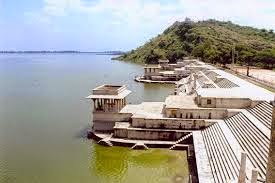
  • The city is named due to Rajsamand Lake, an artificial lake created in the 17th century (1660) by Rana Raj Singh of Mewar.  It is Located 66 kms in the north of Udaipur, Rajsamand Lake lies between Rajnagar and Kankroli. Noticing the dimension of the lake, the lake Spreads to the length of 12 kilo meters and 5.25 kilo meters in width. The lake has the approximate depth of 5 Meters.



  • Kumbhalgarh Fort:
                     Built during the course of the 15th century by Rana Kumbha and enlarged through the 19th century. Occupied until the late 19th century, the fort is now open to the public and is spectacularly lit for a few minutes each evening. Kumbhalgarh is situated 82 km northwest of Udaipur by road. It is the most important fort in Mewar after Chittaurgarh.
                     Build on a hill top of 1100 meters above sea level, the fort of Kumbhalgarh is having a perimeter walls 36000 Meters long. The second longest wall in the world after Great wall of China. The width of the wall in 15 feets. It has seven fortified gateways. There are over 360 Temples in the fort and out of them about 300 temples are Jain temples. From the top of the palace, many kilometers of Aravali Mountain Range can be viewed Easily. Its the Birth place of legendary warrior "Brave Son of India, Maharana Pratap" & Coronation Place of Rana Udai Singh. So high that highly protected from all sides , a type of Giri Durg (Hill Forts).

B. Nathdwara:

        Nathdwara is located in the Aravalli hillson the banks of the Banas river in the rajsamand district, 48 kilometres north-east of UdaipurThis town is famous for its temple of Krishna which houses the idol of Shrinathji, a 14th-century, 7-year-old "infant" incarnation of Krishna. The idol was originally worshipped at JATIPURA Mathura and was shifted in the 1672 from Govardhan hill, near Mathura along holy river Yamuna after being retained at Agra for almost six months, in order to protect it from anti-Hindu fanatic iconoclastic Islamic policies of Mughal ruler Aurangzeb’s. Literally, Nathdwara means ‘Gateway to Shrinathji’. Nathdwara is a significant Vaishnavite shrine pertaining to the Pushti Marg or the Vallabh Sampradaya or the Shuddha Advaita founded by Vallabha Acharya, revered mainly by people of Gujarat and Rajasthan, among others. Vitthal Nathji, son of Vallabhacharya institutionalised the worship of Shrinathji at Nathdwara. Nathdwara town itself is popularly referred to as ‘Shrinathji’, after the presiding deity.

Shrinathji Temple:
As per the religious beliefs, the shrine at Nathdwara was built in the 17th century at the spot as exactly ordained by Shrinathji himself. The idol of the Lord Krishna was being transferred to a safer place from Vrindaban to protect it from the anti-Hindu, iconoclastic and barbarian destruction of the Mughal ruler Aurangzeb. When the idol reached the spot at village Sihad or Sinhad, the wheels of bullock cart in which the idol was being transported sank axle-deep in mud and could not be moved any farther. The accompanying priests realised that the particular place was the Lord's chosen spot and accordingly, a temple was built there under the rule and protection of the then Maharana Raj Singh of Mewar. Shrinathji Temple is also known as 'Haveli of Shrinathji’ (mansion). 

Monday, 20 July 2015

Jodhpur - Rajasthan - India

Rajasthan, the combination of two Hindi words (1) King (2) Place, means Place of Kings.
Before becoming Rajasthan, it was scattered in many small states ruled by different kings of their time. All these states were united by Mewar's Rana's and turned it into a whole big state of India as Rajputana (Rajasthan).
There are so many haritage sites and places which you would like to visit.

Jodhpur:
                           The city was established by Rao Jodha (राव जोधा). Jodhpur is the second largest city in the Indian state of Rajasthan. After its population crossed a million, it has been declared as the second "Metropolitan City" of Rajasthan. It was formerly the seat of a princely state of the same name, the capital of the kingdom known as Marwar. Jodhpur is a popular tourist destination, featuring many palaces, forts and temples, set in the stark landscape of the Thar Desert.
                           The city is known as the "Sun City" for the bright, sunny weather it enjoys all the year round. It is also referred to as the "Blue City" due to the vivid blue-painted houses around the Mehrangarh Fort. The old city circles the fort and is bounded by a wall with several gates. However, the city has expanded greatly outside the wall over the past several decades. Jodhpur lies near the geographic centre of Rajasthan state, which makes it a convenient base for travel in a region much frequented by tourists.
Jodhpur topped Lonely Planet's list of most extraordinary places to stay in 2014. An upcoming Tamil movie, I, which is the costliest Indian film to date, was also shot at Jodhpur. 
  • Mehrangarh Fort:
                                  It is one of the largest forts in India. The fort is situated 120 metres (400 ft) above the city and is enclosed by imposing thick walls. Inside its boundaries there are several palaces known for their intricate carvings and expansive courtyards. A winding road leads to and from the city below. The imprints of cannonball hits by attacking armies of Jaipur can still be seen on the second gate. To the left of the fort is the chhatri of Kirat Singh Soda, a soldier who fell on the spot defending the Mehrangarh fort. There are seven gates, which include Jayapol (meaning 'victory'), built by Maharaja Man Singh to commemorate his victories over Jaipur and Bikaner armies. Fattehpol (also meaning 'victory') gate was built by Maharaja Ajit Singh to mark the defeat of the Mughals. The palm imprints upon these still attract much attention even today.
                                The museum in the Mehrangarh fort is one of the most well-stocked museums in Rajasthan. In one section of the fort museum there is a selection of old royal palanquins, including the elaborate domed gilt Mahadol palanquin which was won in a battle from the Governor of Gujarat in 1730. The museum exhibits the heritage of the Rathores in arms, costumes, paintings and decorated period rooms.
  • Ummed Bhavan Palace Museum:
  • Mandor Garden: A garden like place for the royal family. Means for queens and  princesses. 
  • Jaswant Thada:
                                It is an architectural landmark located in Jodhpur. It is a white marble memorial built by Maharaja Sardar Singh of Jodhpur State in 1899 in memory of his father, Maharaja Jaswant Singh II. 

    The monument, in its entirety, is built out of intricately carved sheets of marble. These stones are extremely thin and polished so that they emit a warm glow when the sun's rays dance across their surface. 
    Within this cenotaph, there are also two more tombs. The Jaswant Thada is a traditional cremation ground of Jodhpur rulers. The grounds also include exquisitely carved gazebos, a beautiful mulch-tiered garden, and a small lake. To the left of the Mehrangarh Fort complex is the Jaswant Thada of Jodhpur, Rajasthan. It is a 19th-century royal cenotaph built in commemoration of Maharaja Jaswant Singh II, the 33rd Rathore ruler of Jodhpur. The son of Maharaja Jaswant Singh, Maharaja Sardar Singh, in the memory of his father, built the Jaswant Thada. The cenotaph has two more tombs within it. Near to this are the royal crematorium and three other cenotaphs.
                                 Famous Jaswant Thada in Jodhpur is an example of architectural brilliance in India. It is a white marble memorial, built out of intricately carved sheets of marble. The carving shows the genius of the sculptors. There is also beautiful marble jali work on the cenotaph. You can have some nice views from the terrace in front of the cenotaph.
    The cenotaph of Maharaja Jaswant Singh displays portraits of the rulers and Maharajas of Jodhpur.[2] The main memorial has been built like a temple. To visit the Thada you have to go through the rocky hills. This also lends a mystic aura to the whole visit.
  • Baalsamand Lake:
                  It is a lake situated 5 km from Jodhpur on Jodhpur-Mandore Road. This lake is a popular picnic spot, built in 1159 AD by Balak Rao Parihar. It was designed as a water reservoir to provide water to Mandore. The lake has a length of one km, breadth of 50 m and a depth of 15 m. The Balsamand Lake Palace was built later as a summer palace on its shore. The lake is surrounded by lush green gardens that house groves of trees like mango, papaya, pomegranate, guava and plum. Animals and birds like the jackal and peacock also call this place home.
  • Kailana Lake:
                 It is located 8 km west of Jodhpur. It is an artificial lake, built by Pratap Singh in 1872. The lake spreads over an area of 84 km2. In ancient times this region had palaces and gardens made by two rulers of Jodhpur - Bhim Singh and Takhat Singh. These were destroyed to make Kaylana Lake. The lake is situated between igneous rock land formations. It receives its water from Hati Nehar (translation: elephant canal), which is further connected to the Indra Gandhi canal. The natural vegetation here mostly consists of Babool trees (Acacia nilotica), and various migratory birds such as Siberian cranes are seen here in the winter season. The city of Jodhpur and all the surrounding towns and villages depend on Kaylana lake as a source of drinking water
  • Rav Jodha Desert Rock Park:
  • Clock Tower: 

Fairs and festivals

  • Marwar Festival
  • Gangaur
  • Baithmaar Gangaur Mela
  • Teej
  • Nag Panchmi Fair
  • Sheetla Mata Fair
  • Baba Ramdev Pir Mela

Temples

  • Chamunda Mata Temple (nearby Mehrangarh Fort)
  • Raj Ranchhodji Temple
  • Achal Nath Shivalaya
  • Siddhanth Shiv Temple
  • Rasik Bihari Temple
  • Ganesh Temple
  • Baba Ramdeo Temple, Masuria hill, Jodhpur
  • Shiv Temple, Shiv Sagar, Mata ka than, Jodhpur
  • Udai Mandir in city area
  • Kunj Bihari Temple
  • Dauji Temple, Hathi Ram ka Oda, Jodhpur